Report Launch
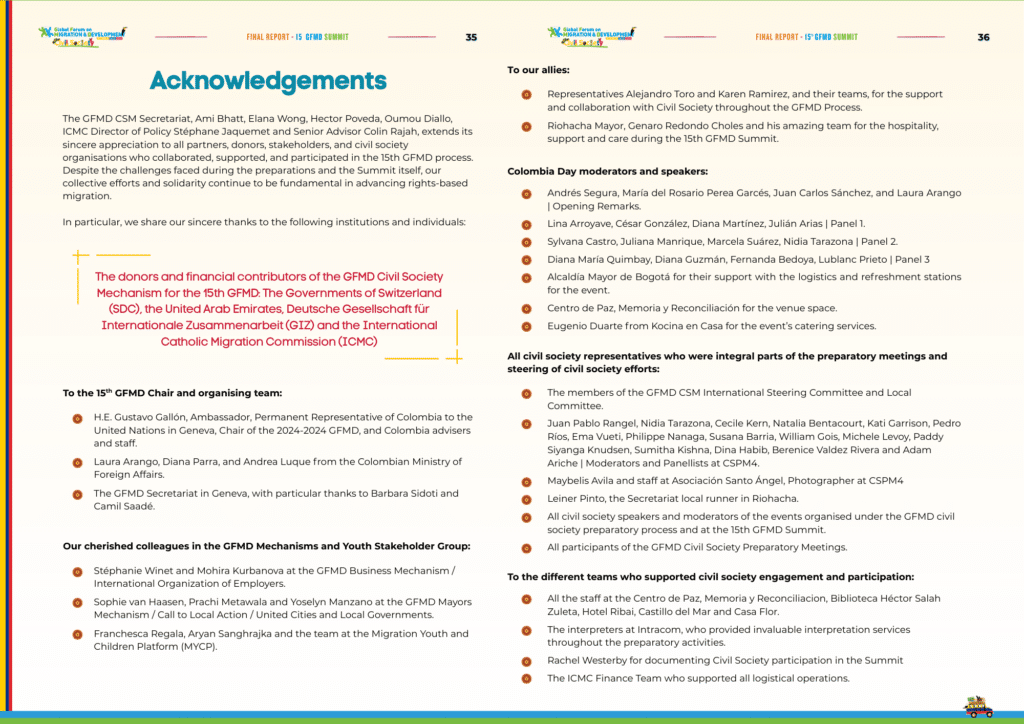
We are pleased to share the Civil Society Report of the 15th Global Forum on Migration and Development (GFMD), covering the 2024–2025 cycle under the Colombian Chairship and the Summit held in Riohacha in September 2025.
Find the report here:



Over the past years, anti-migration narratives have become increasingly normalised across many regions. Civil society and grassroots organisations have had to navigate a changing world where human rights are openly questioned, where shrinking space, funding uncertainty, and growing political pressure are the norm in many parts of the world, all while they continue to accompany migrant communities and advocate for rights-based approaches. In this world, multistakeholder spaces such as the GFMD have remained important points of connection, dialogue, coordination and resistance, supported by governments and partners committed to meaningful civil society engagement.
Building on the work of previous cycles, particularly the innovations introduced under the French Chairship, the Colombian process sought to strengthen participation, deepen dialogue, and more closely connect global discussions to local realities. This ambition shaped thecivil society preparatory process and strategy from the outset.
Looking ahead: collective strength and action in perspective
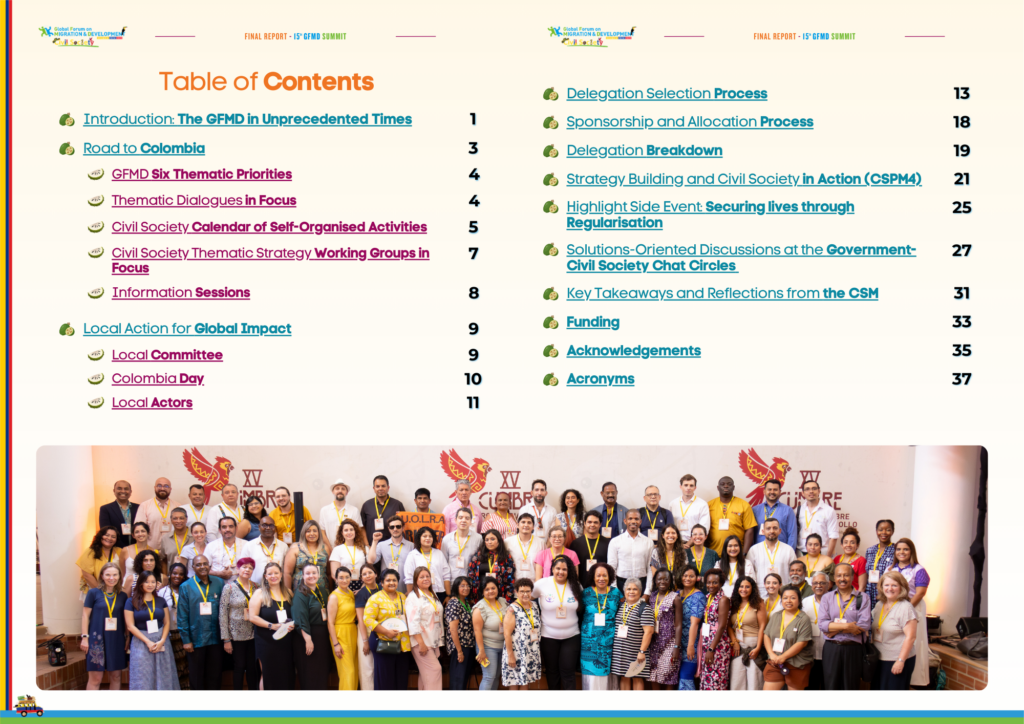
If there is something that civil society knows is that we are a force to be reckoned with. This report shows how we organised ourselves, supported one another, and made collective choices during a demanding and at times challenging cycle, and it reflects the many hours of coordination, debate, learning, and care that went into that work.
The context in which we operate has not become easier. On the one hand, many organisations continue to operate in hostile environments, amid a climate of rising, normalised xenophobia and discrimination, the dismissal of human rights, and increasingly flagrant contraventions of international and domestic law. On the other hand, expectations of civil society to respond, represent, and deliver keep growing.
What this process confirmed, once again, is that our strength lies in our solidarity and collectivisation, in staying connected, sharing information, building trust, and being honest about what works and what does not. The Road to Colombia and the collective moments in Bogotá and Riohacha were a testament to our drive to make the world a safer place for people on the move.
As we look towards the next phases of global migration governance, including the 2026 International Migration Review Forum (IMRF), these experiences matter. They remind us that meaningful participation does not happen automatically. It requires time, coordination, transparency, and sustained investment in one another.
From reflection to collective strategy – The Road to Colombia
From mid-2024, the GFMD Civil Society Mechanism launched the “Civil Society Road to Colombia,” a process comprising a series of capacity- and solidarity-building activities to bring together grassroots organisations, migrant-led groups, trade unions, faith-based organisations, human rights defenders, diaspora networks, and regional coalitions worldwide.
Following the GFMD programme consultations in July, civil society worked collectively through thematic dialogues, working groups, and information sessions to refine advocacy messages, share experiences and challenges, identify priorities, and narrow down a strategy for civil society participation in all stages of the 15th GFMD process, including the preparatory meetings and the summit itself.
A key feature of the preparatory process was its building-block approach, mirroring the Chair’s vision for a sequence where each Roundtable Consultation feeds into the next:
- The first explored challenges and opportunities related to the six thematic priorities.
- The second focused on the exchange of policies and practices
- The third, eventually merged with the Summit itself, looked at solutions and partnerships.
Learn more about the civil society participation in the GFMD preparatory meetings:
First and second
Within the ‘Road to Colombia’ preparatory process, the ‘Civil Society Thematic Dialogues’ (TDs) took centre stage. These sessions were dedicated to strengthening collective advocacy, reflecting on the Chair’s thematic priorities, and providing space for wider civil society to respond to shifting regional dynamics and plan actions beyond the GFMD process. The range of topics covered in the TDs reflected direct applicability to the Chair programme and attentiveness to the changing context, which later necessitated a general approach of ‘no business as usual’. This approach fostered thinking grounded in the realities of all participating organisations and recognised the potential of the GFMD as a dynamic process shaped at the local, regional and international levels.
Each TD produced an Advocacy Brief that translated collective reflection into concrete proposals and coordinated action.
Find the advocacy briefs:

From dialogue to action: Resist, Reclaim, Realise
The fourth and final Civil Society Preparatory Meeting (CSPM4) was organised around the “Resist, Reclaim, Realise” campaign.
- Resist centres around the need to push back against the facilitation, co-optation and weaponisation of discrimination, fear, and misinformation being used to threaten migrants and their families, divide our communities, and breach fundamental human rights and laws.
- Reclaim focuses on understanding what has been lost or led astray in global understanding and narratives around migration, human rights, and community. It calls on civil society to deeply understand the root causes behind these, and strategically assert and/or re-affirm the terms, narratives and institutions that must be built for a just, equitable world.
- Realise brings these together to create action, to ‘realise’ a better future where all migration-related governance and policy is rooted in respect for human rights and dignity. This calls us to work together in solidarity, mutual support and combined, collective strength.
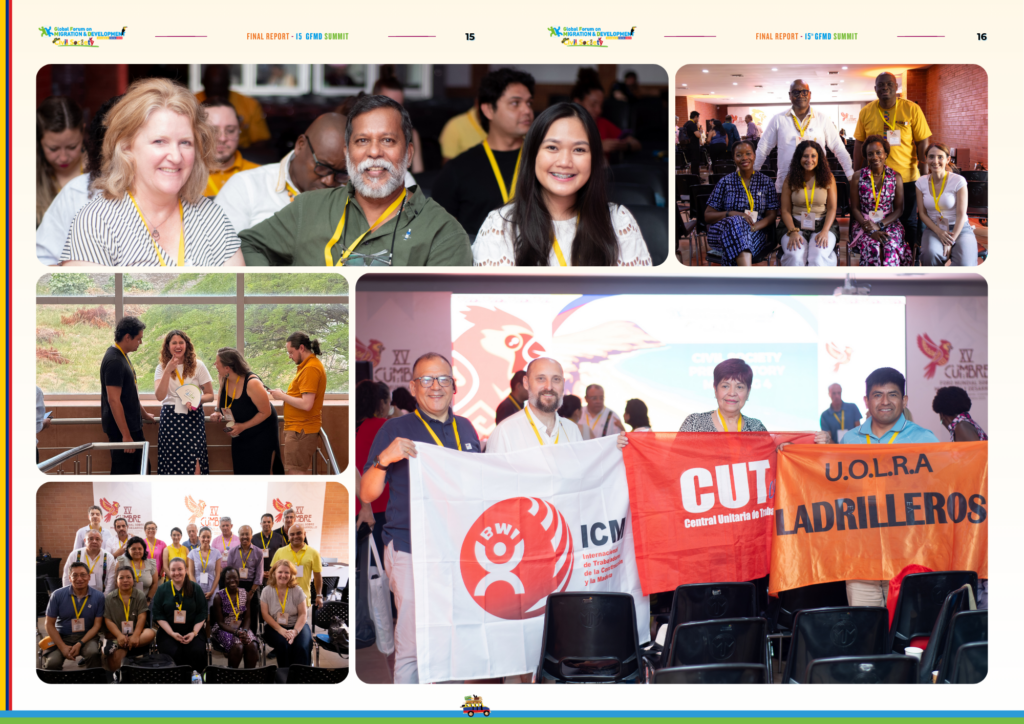
This framing reflected civil society’s shared assessment that “business as usual” was no longer sufficient. During CSPM4, delegates discussed how to resist discrimination and misinformation, reclaim rights-based narratives and institutions, and realise collective action grounded in solidarity and mutual support.
We invite you to read the report for more details on how this session developed. You can also find more information on CSPM4 in this article.
Making participation accessible and transparent
Ensuring broad, informed, and inclusive engagement in the 15th GFMD process was a core priority. Between October 2024 and April 2025, the Secretariat organised five online information sessions at the global and regional levels. These sessions explained how the process worked, clarified eligibility criteria, and provided accessible entry points for organisations engaging for the first time.
In Colombia, a Local Committee (LC) was established in early 2025 to support national and diaspora engagement. The LC served as a bridge between Colombian civil society and the global process, coordinated information sharing, and led the selection of national delegates in accordance with agreed principles. Their work was essential to ensuring transparent, accountable, and locally grounded participation.
In the report, you will find more information regarding the delegation selection process, breakout sessions, and other relevant information regarding Civil Society participation in the 15th GFMD Summit.
We hope the report is useful, honest, and reflective of the work that so many of you made possible.
Thank you!
Elana, Oumou and Hector
GFMD Civil Society Mechanism Secretariat
Find the report here: