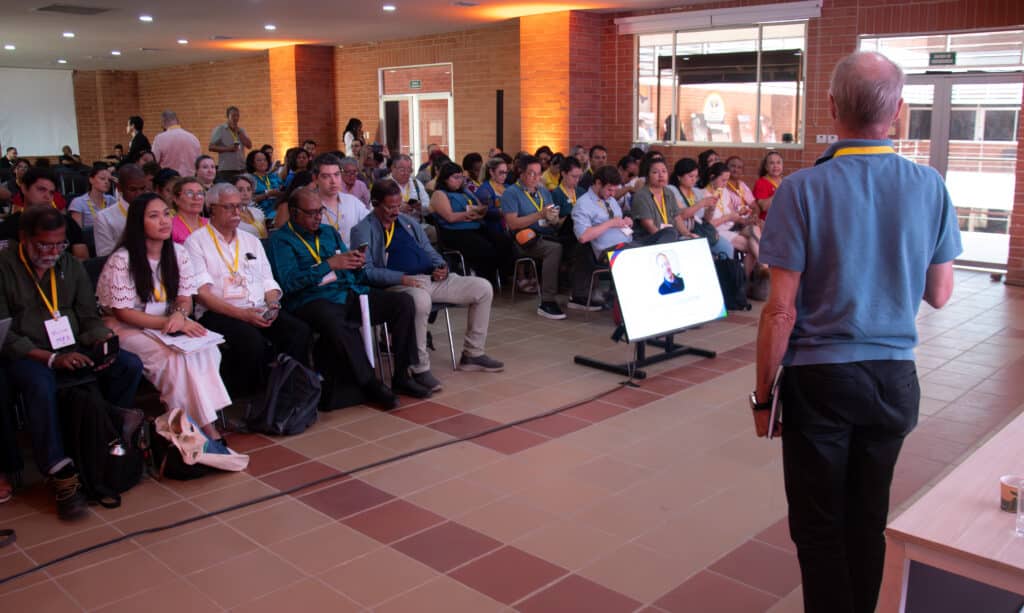
The 15th Summit of the Global Forum on Migration & Development took place in Riohacha, Colombia, on 2-4 September, and the second International Migration Review Forum is scheduled for 2026. In a rapidly changing migration environment, ICMC Director of Policy Stéphane Jaquemet reflects on how we got here and the future of international migration processes.
By Rachel Westerby
To read this article in English or any other language, please select your preference from the bottom left corner of the website.
ICMC: Many thanks, Stéphane, for sitting down with us! We’re speaking after the GFMD Summit, which took place on 2-4 September in Riohacha, Colombia, under the Colombian Chairship. What are your reflections on both a first GFMD Summit in Colombia, and on the participation of civil society?
SJ: Happy to talk! The first thing I would say is that it was positive to have the GFMD Summit in Colombia. We’ve seen Colombia has been a something of a different state voice in the current context: it hosts almost 3 million Venezuelans and has the largest regularization programme in the world by far, for example, which should be a model for the rest of the world. The Colombian government has also been quite vocal in promoting international standards and criticizing forced deportations within the region.
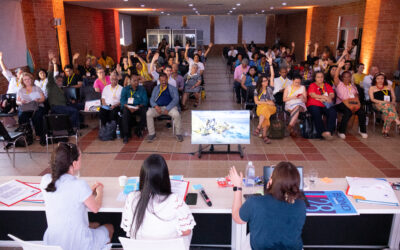
The fact that it was in the city of Riohacha was also positive, in the sense that this global process took place close to communities impacted by migratory movements. Local authorities and NGOs that are directly impacted were also able to be there and be heard. The late change of date and location of course meant some delegations were represented at a lower level, and the venue capacity meant less people could be accommodated. But overall, being in Colombia and in Riohacha were positives.
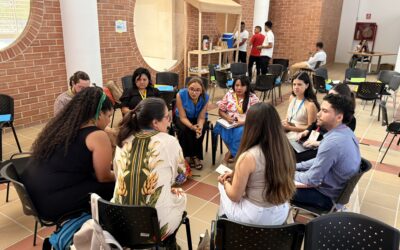
In terms of our delegation, as the Civil Society Mechanism, we managed to conduct a really healthy selection process throughout our regional networks. At all Summits, we try to have a strong regional and local representation, because the Chair by definition will select priorities that are very linked to the local and regional situation. In Riohacha, civil society from Latin America were in a small majority, and I was also very happy to see our diversity in terms of representation from Africa, Asia, Europe, the Middle East, North America and the Pacific.
There was a really Latin American flavor to the Summit, which for me was positive because the region has a number of migration challenges and priorities that are very much part of the global agenda. One is forced returns, alongside U.S. policy in relation to closing the border. Another is retaliation against some governments in the region because they are not aligned in terms of migration policies, especially on the readmission of their citizens. These are a reflection of global challenges and priorities, and that was very useful.
ICMC: Both the Summit and the entire 2024-25 GFMD process took place in a much changed – and rapidly changing – global environment for migration policy and governance. Where are we now, and how did we get here?
SJ: Amongst what we might call ‘like-minded people’ – meaning NGO colleagues, those working for international organizations and so on – there is a general agreement that the current situation is very complicated.
From our position as a coordinator of civil society in global migration governance processes, we can of course attest to the increasingly negative narratives on migration around the world. But we also have the impression that government representatives who previously advocated for balanced approaches to migration are now not only in a minority, but are avoiding talking about migration at all. So the discourse today is very much dominated by those saying that migrants are a problem, and that they contribute to social and economic problems such as a loss of national identity or to increased unemployment.
Moreover, when we analyze EU documents, including the conclusions of the various summits of EU heads of state and government, we regularly see minimal discussions of the positive impacts of migration and the contributions of migrants. Instead, the focus is almost exclusively on priorities in areas such as increasing forced returns, border controls, and the fight against irregular migration.
This aspect is also borne out in EU diplomacy. At the September 2025 UN General Assembly in New York, for example, President Trump gave an incendiary speech that heavily criticized Europe, and identified migration as the biggest driver for what he sees as Europe’s problems. I was particularly struck by the almost total lack of response by EU leaders, and the fact that no one openly defended human rights and European values.
In terms of how we got here, the current situation has deep roots in the past. The concept of ‘Fortress Europe’ was built in the late ‘80s and early ‘90s, so we’ve seen policies becoming more and more restrictive over the past 30 years. Calls for more returns from Europe, for example, date back to this period, and we see similar language and a similar reluctance to consider alternative approaches throughout the conclusions of EU institutions over the same timeframe. It’s therefore not accurate to say that President Trump introduced these ideas, which then became a ‘model’ for the rest of the world. Unfortunately, he’s also reflecting and amplifying a trend that pre-dates him.
That said, there are a number of recent developments that very clearly point to an acceleration and degradation of the situation. Before the current U.S. administration, for example, states would exceptionally deport people to a third country, meaning a country that is not their country of origin or nationality. Today, some states and governmental authorities are creating hubs for return that have zero links with countries of origin, and no guarantee or accompanying measures or systems to convince countries of origin to readmit their citizens – assuming that such a return is safe, and respects the principle of non-refoulement.
So now we deport Bangladeshis or Sudanese to El Salvador, for example, but there is no kind of attempt to find out what the conditions are there, or what will happen to people in the longer term. So we are in an era of mass deportations, which very clearly contravene the key principles of both international migration and international refugee law, and some states are saying “we don’t care how much it costs or what happens to people, we’ll do it anyway.”
We can see this very clearly in the real lack of shame, across political actors and voices beyond what we refer to as ‘the far right’. There is no longer much willingness to be – or even be seen to be – politically correct. Prior to COVID, I think it’s fair to say that there were instances of states violating migrant rights, and that in some cases these violations continued over sustained periods. But there was at least a sense of embarrassment, and that is now disappearing, sometimes abruptly. It’s not only that some states don’t feel guilty, it’s that they are also proud of what they are doing in terms of violating rights. For me, this is the most fundamental and tragic recent shift.
ICMC: In the current environment that you describe, what is the value of continued civil society dialogue with governments?
SJ: We are living in with the results of the trends that have developed from the early 1990s until now, a more or less thirty-year long pathway of increasingly restrictive policies. Throughout this period, I would say up until COVID, there was always a willingness from governments to have a dialogue with civil society. It didn’t always produce material policy change, but where there’s a willingness to engage in dialogue you can also make gains in terms of policies being implemented in a more liberal and humane way. But now, the policies are the same in terms of restrictiveness, and there is also an inhumane approach to their implementation.
Here, it might be easy to conclude that dialogue no longer makes any sense, because it’s just “we are right and you are wrong”. It’s always a problem for civil society in any meeting with governments, this question of how we convince governments to change their policies, to bring them in line with human rights and toward a more respectful attitude toward migrants. It’s also extremely challenging to be in dialogue with some states when we see that they are routinely violating human rights. As civil society we do not adopt policies, and while we can have a dialogue with governments, if it has no impact then we have to ask ourselves if it’s worth it.
So of course, it’s legitimate to ask if the GFMD still means something, and for me the answer is both yes and no. No, because the GFMD will not fundamentally change the approach of the most extreme countries in terms of migration policies: they will keep deporting people in an inhumane way, for example, and stop rescuing people at sea. It’s very hard to see how we can build a coalition against those practices.
But on the yes side, it’s still so important that the like-minded can keep talking to each other, and that you can still have civil society, countries of origin, and countries of destination in direct dialogue. The GFMD is still a platform where pragmatic issues can be discussed, and those pragmatic issues can have an impact for some migrants, in some cases. Like everything related to internationalism and multilateralism, it’s better to keep it alive for better times. Our objective can be solely to maintain a dialogue, knowing that we may not have an impact today, but that we will be ready for a tomorrow when, maybe, there will be a better environment. For me that’s important.
We should not be naïve or triumphant in thinking that nice meetings will change the world, because they won’t. But if we remain realistic and understand our limitations, and avoid thinking about it in terms of immediate, quantifiable objectives, then dialogue is always positive. I see our task now as maintaining an environment of dialogue and alliances, to ensure that we have the possibility to seize opportunities when they happen. So, in short, the GFMD remains both legitimate and meaningful.
ICMC: So you see a value in maintaining dialogue, but what about the broader civil society coalition contributing to processes like the GFMD and the International Migration Review Forum (IMRF)? Are there other civil society perspectives on the value of dialogue right now?
SJ: Well, the GFMD began in 2006-7, and while it started relatively slowly from a civil society perspective, there were then a number of Chairs and Summits where I think we were really building something. I would say that the New York Declaration in 2016 was the peak of mobilizing the international community for migration governance, and that the momentum continued to some extent with the adoption of the Global Compacts, in particular the Global Compact on Migration (GCM). From 2018, however, we have been on a very slippery slope. If we look at the first IMRF in 2022, for example, the Progress Declaration on the GCM’s implementation can be broadly summarized as ‘very little progress’.
Given this very downward direction, what dynamic is now present in civil society? For me, the position was made very clear at the GFMD Summit in Riohacha, where the entire civil society delegation launched a joint campaign, for the very first time. There have of course always been individual campaign-type actions linked to the GFMD, implemented by specific sections of civil society that wanted to do that. But at this Summit, civil society collectively decided that just being there wasn’t enough, and that what was needed was a joint civil society campaign focused on what is happening right now to migrants.
So there’s a lot of unity amongst civil society at the moment. I was also impressed because everything related to the relationship with governments has always been a really contested question for civil society, and a process of not necessarily agreeing on everything. There are sections of civil society that have always advocated for the continuation of dialogue even under difficult circumstances, for example, and others who advocate boycotting dialogue at a certain point if we don’t get the immediate results we want.
Now, there’s a shared sense that many states are not listening to us, and a shared understanding that we need to build a broader civil society coalition. The campaign moves us beyond just the NGO world, and creates a space in which a much wider group of people can express their concerns and lend their support.
ICMC: How optimistic are you about the future of the GFMD?
SJ: I still think that the GFMD can be very useful, and can obtain results. I absolutely believe that the informality of the GFMD process is especially important at the moment, because you would not see any meeting around migration with a more binding or formalized structure being as successful.
It make sense to have the GFMD as a parallel process to the Global Compacts and the IMRF, which have some extent become too formal. We still need to have this place where governments can discuss difficult questions in an informal manner – this is maybe the only way to move forward at present. The alternative is bilateral conversations between mainly destination countries and countries of origin and transit, and we know very well that this kind of dialogue is influenced primarily by the desires of destination countries to ‘resolve’ their irregular migration problems. I don’t think there’s too much to expect from bilateral conversations at the moment.
So precisely because we are at a difficult moment, and precisely because we are not seeing the kind of outcomes we want to see, we need to be patient and obtain the best we can get. And at the moment, our best is to maintain open dialogue, and make sure that most governments are ready to have that kind of dialogue. We must focus our efforts on changing the attitudes of some governments, so that things are done in a more humane way.
In Riohacha, despite the wider negative context, I was still impressed by a number of governments who took the floor and made strong statements in support of the process and dialogue, and some clear commitments on more positive policies in areas such as regular pathways. My experience of the GFMD is that governments feel relatively able to speak more freely, because no-one is going to quote them directly. In this sense, the GFMD continues to win the day because of the non-binding and informal nature of the process. But imperatively, both the GFMD and other multilateral processes must be complemented by principled and independent civil society advocacy and campaigning.