
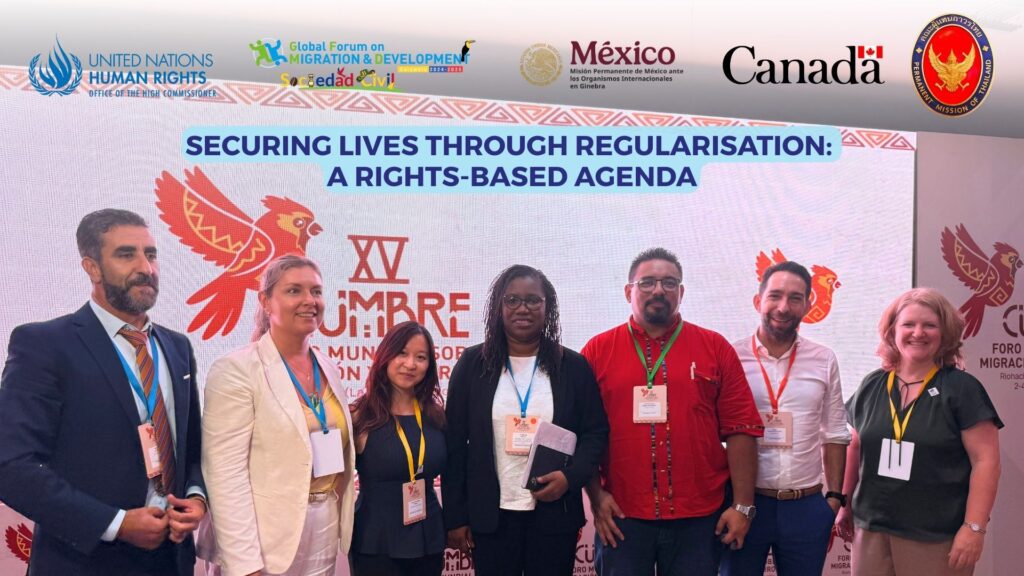
On the second day of the 15th GFMD Summit in Riohacha, Colombia, the GFMD Civil Society Mechanism co-hosted a side event sharing lessons learned from successful regularisations programmes and mechanisms, and recommendations for future rights-based approaches
By Rachel Westerby
On the first day of the 15th Summit of the Global Forum on Migration and Development (GFMD) process under the Colombian Chairship, held in Riohacha on 2-4 September 2025, approximately 40 Forum participants attended the official side event ‘Securing lives through regularisation: a rights-based agenda’.
Co-organized by the Office of the United Nations High Commissioner for Human Rights (OCHCR) and the GFMD Civil Society Mechanism, the event was convened at a time when hostile migration narratives and policies are causing regular pathways, including regularisation, to be limited or deprioritised.
‘Securing lives through regularisation: a rights-based agenda’ sought to share perspectives and lessons learned from successful regularisation programmes and mechanisms across stakeholders, highlight the positive impacts of regularisation for migrants and communities, and re-centre human rights for all in the regular pathways discourse.
Regularisation: The Global State of Play
“Regularisation is an umbrella term for both targeted, time-limited programmes and ongoing legal mechanisms designed to resolve irregular status,” explained Byron Cardenas Velasquez of OCHCR, in opening remarks delivered alongside Hazel Contreras of Alianza Americas. “In either case, it is about recognising people’s presence on a territory, and enabling them to stay and prosper in the communities where they have built their lives.”
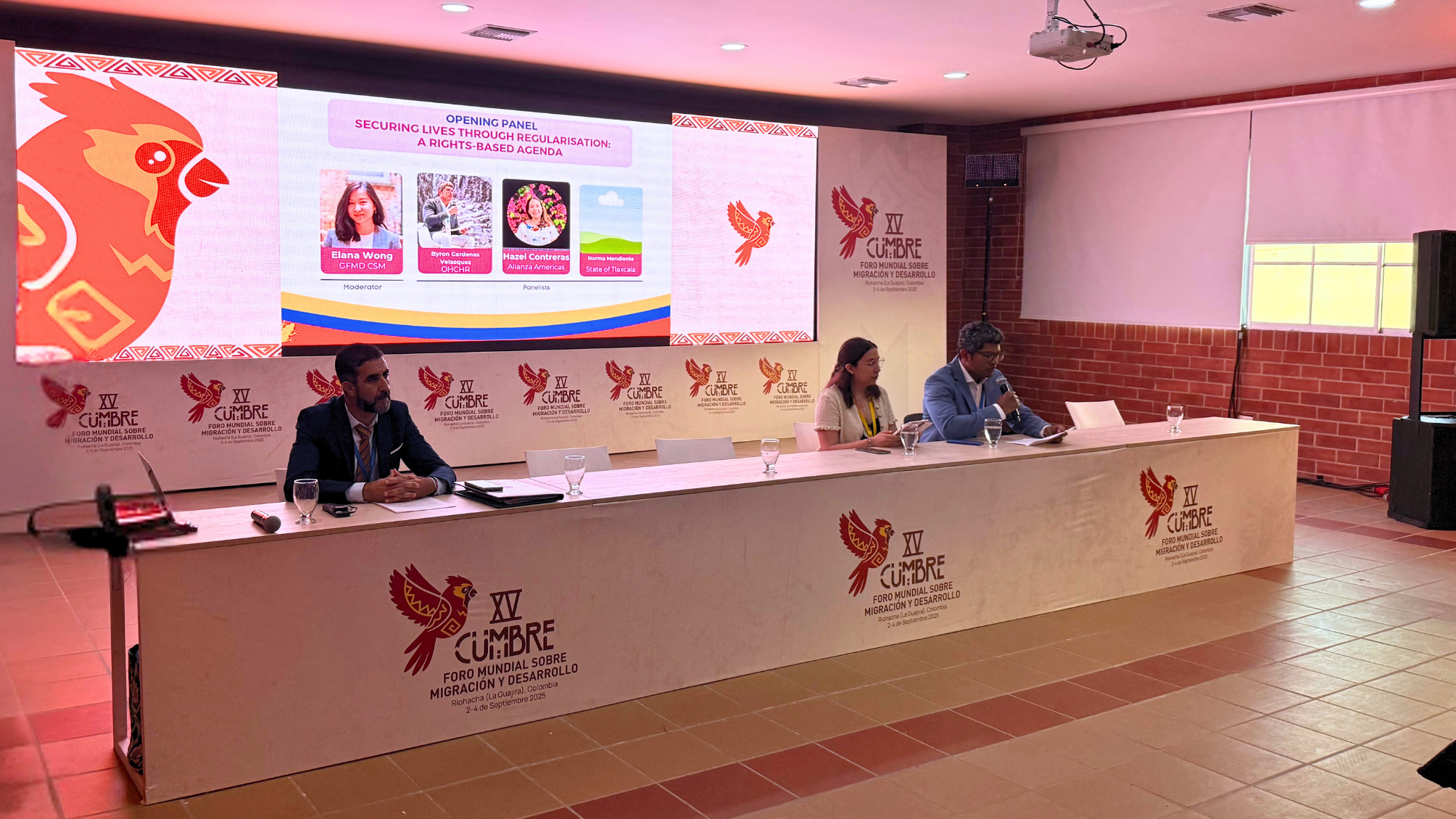
Regularisation is a common policy tool, with many examples of implementation by States around the world.
“Our research in the context of the Freemove Project found multiple examples of regularisation initiatives and mechanisms, implemented in a diverse range of political and migration contexts,” reported Professor Diego Acosta of the University of Bristol in the UK. “In Italy in 2005, for example, an initiative by the Berlusconi government led to the regularisation of 600,000 people, the largest group being Romanian nationals. More structural examples are seen in Spain, which provides a clear pathway to citizenship for Venezuelans, and in the application of the Mercosur residence agreement with respect to Venezuelans in Argentina and Uruguay.”
A striking recent example of high impact regularisation can be found in Thailand, which enacted legislation in late 2024 that has to date regularised the status of 420,000 people, 120,000 of whom are children. “This equates to more than 80% of stateless children in Thailand, which is a phenomenal outcome,” said Anna Azaryeva of the United Nations Children’s Fund (UNICEF).
The side event took place against the backdrop of the significant achievements of Colombia, which has pioneered large scale, high impact regularisation programmes. “Countries such as Colombia have demonstrated that inclusive regularisation can have profoundly positive impacts for both migrants and wider communities,” said Hazel Contreras of Alianza Americas. “So while it’s the right thing to do, it is also smart policy that promotes stability and development.”
The side event also presented an example of efforts to promote regularisation within States, implemented in the central Mexican state of Tlaxcala. “We are seeing an increasing number of returning migrant adults who were not legally registered at birth, either here in Mexico or in the U.S.,” explained Victor Hugo Mena Hernandez, representing the state of Tlaxcala in Mexico. “It is extremely difficult for them to access documentation at this point, and we are trying to resolve this lack of legal status and protection via a dedicated state project.”
“The Benefits are Impossible to Overstate”: Impacts of Regularisation
There is a strong evidence base detailing the positive impacts of regularisation, for migrants and their families, and for the wider communities and countries in which they live.
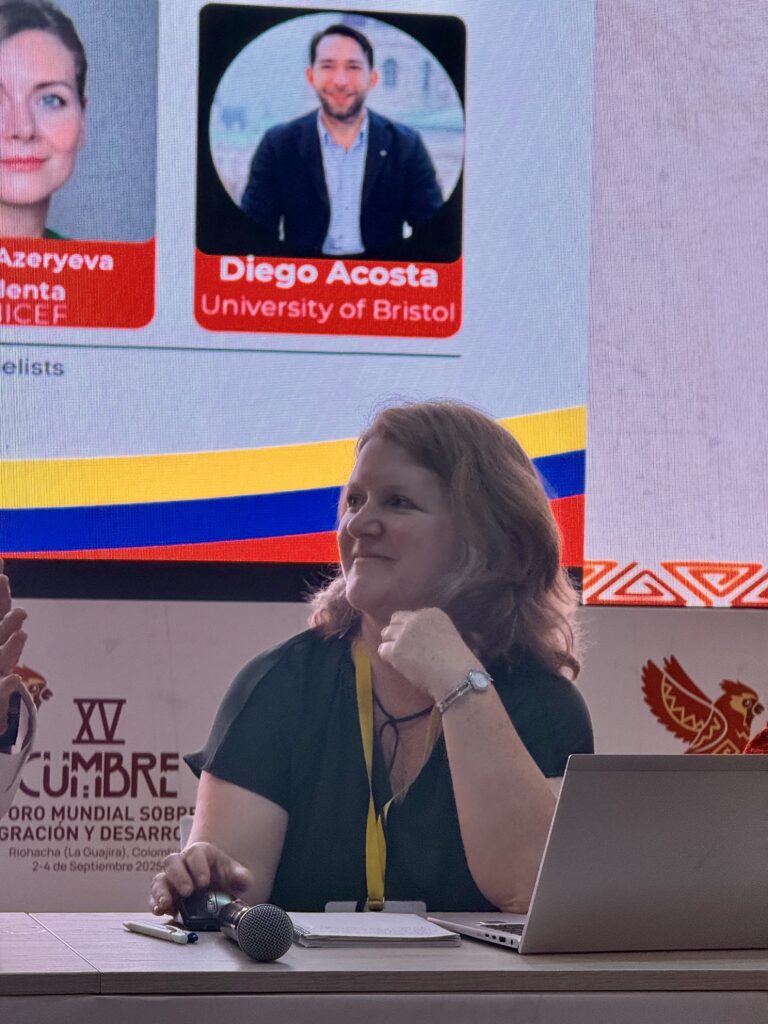
“We analysed research on regularisations that took place during the past five decades, in the U.S., Latin America, and Europe, to determine what the evidence base can tell us about impact,” explained Michele Levoy of the Platform for International Cooperation on Undocumented Migrants (PICUM). The findings with respect to impacts of resolving irregular status for individuals include improved living conditions and mental health, freedom to move and travel in safety, and the ability to find regular, more secure work that is better aligned to individual skills and aspirations and better paid.
“One evidenced impact that really surprised us was that for the next generation,” Levoy stated. “When expectant mothers are able to regularise their status, the birth weight of newborn babies increases. This speaks so clearly to the improvements in access to health and maternity care that regularisation provides.”
Positive impacts of regularisation are also seen at the community and society level. “There are of course many social benefits created by more equal and healthier communities, but the evidence also shows how regularisation has very tangible economic impacts,” said Levoy. “In France, a 1981 exercise to regularise the status of 130,000 workers led to a 1% increase in GDP, and in many cases resolving the irregular status of workers improves conditions for other workers.”
Regularisation has particular impacts for children. “At a very basic level, regularisation enables children to access the rights they should be guaranteed by the United Nations Convention on the Rights of the Child,” said Anna Azaryeva. “Moving out of an irregular situation negates the need for children to be detained for immigration purposes, for example, so the benefits are impossible to overstate.”
She detailed how families in an irregular situation fear interactions with public authorities, to the extent that they may not send their children to school or access the healthcare that they need. “Even where legal frameworks guarantee access to public services for undocumented children, such as education, there are still significant administrative barriers such as requirements for official documentation in order to register.” She also detailed how regularisation opens access to formal work, enabling families to invest in their futures and create solid, positive pathways for their children.
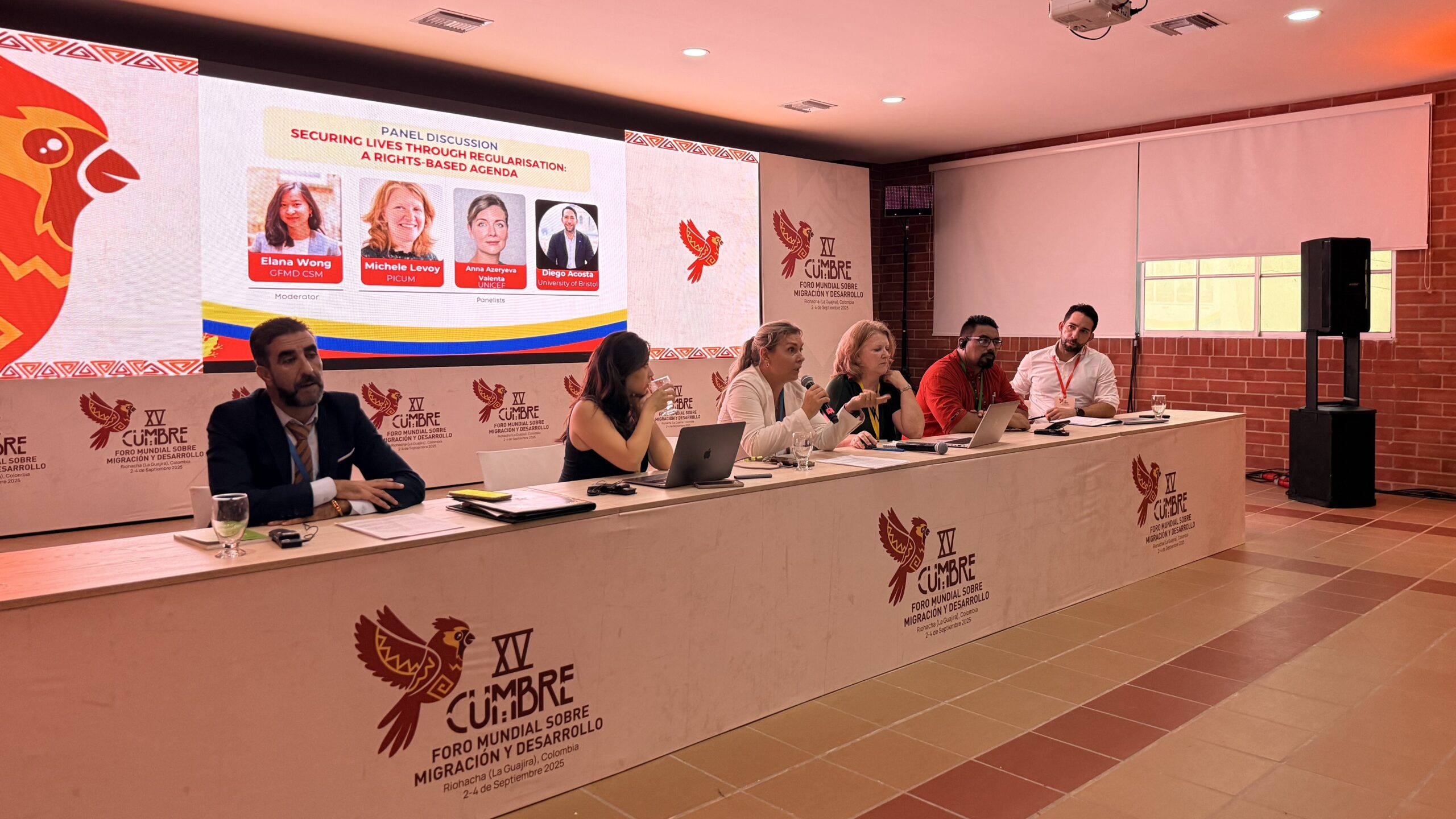
Experiences in Tlaxcala, Mexico, point to the long-term impact of being undocumented as a child. “Children who weren’t registered at birth cannot prove their identity, meaning that in official terms, they don’t exist,” explained Victor Mena Hernandez. “They’re not included in social programmes, and cannot access proper housing, health, education or work. They live in situations of acute vulnerability: it’s inhuman.”
Looking to the Future: Recommendations for Improved Approaches to Regularisation
Panellists set out several key recommendations to improve regularisation programmes and mechanisms. These include clear and objective eligibility criteria, accessible application procedures, a right of appeal, and the involvement of civil society in programme design. “We would also highlight that many of the positive impacts of regularisation are negated when the status that is provided is temporary, or when it ties individuals to a specific employer,” said Michel Levoy.
The side event crystallised the reactive nature of many regularisation initiatives. “We see a strong tendency for programmes and mechanisms to address the issue of people who are already in an irregular situation,” explained Professor Acosta. “What’s missing is preventive policies that address how people end up in this situation to begin with.”
The impact of a lack of proactive and preventive policymaking often becomes clear at a time of crisis. “The global COVID pandemic demonstrated that having an irregular population creates risk,” said Anna Azaryeva. “So emergencies make governments realise what can and should be done, but policymaking should be proactive and not a last resort in response to prevailing circumstances.”
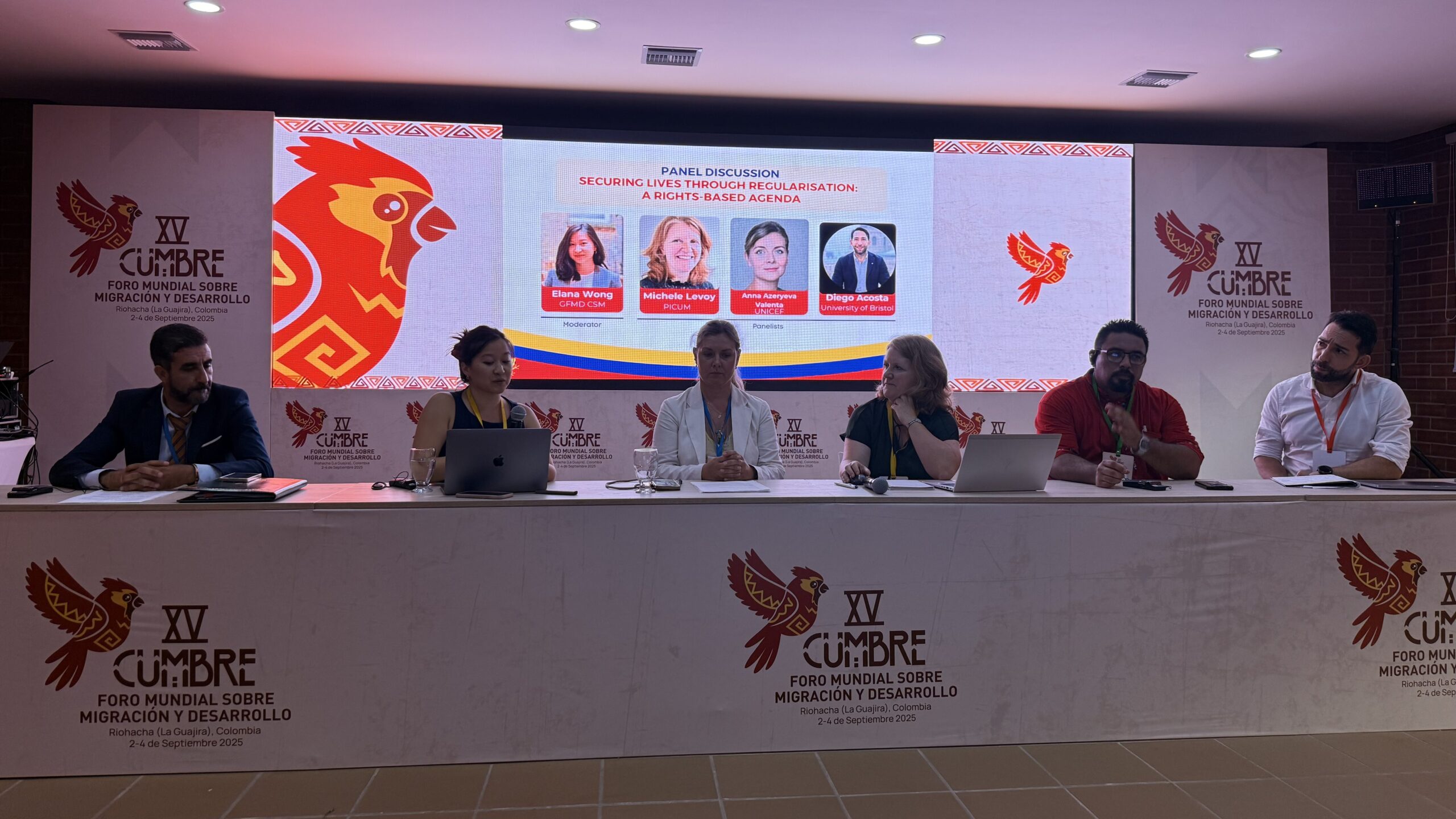
The event also highlighted the central importance of strong and effective international action and multilevel partnerships for the success of regularisation initiatives. “In Thailand we saw that global processes and pledges, including for example the global campaign to end statelessness, really created the political will for the government to act,” said Azaryeva. “That the regularisation process was reduced from several months to just 5 days was thanks in large part to partnerships with international organisations providing technical support. There is still a large population waiting, but this is a massive improvement that speaks to what can be achieved when partnerships are in place.”
Partnerships also involve building the capacity of key stakeholders to understand and implement regularisation. “Migrants are powerless when administrative or immigration authorities make incorrect decisions or discriminate against them,” said Mena Hernandez. “These actions are often a result of a simple lack of official awareness about regularisation rights and processes, which we need to address.”
Looking to the Future: Reclaiming the Regularisation Narrative
Side event discussions highlighted the disconnect between state regularisation practices and state narratives on ‘regularisation’.
“We saw that European states were very reluctant to include the term ‘regularisation’ in the text of the Global Compact for Migration, for example, even though the concept itself is there in the document,” said Michele Levoy. “Their lack of comfort with the term contrasts quite sharply with the fact that 24 European Union countries implemented some form of regularisation during 1996-2008.”
“We also see that many states are scared of the term and its negative connotations, even where they’re doing it at large scale,” said Professor Acosta. “It’s popular wisdom the U.S. has not undertaken any regularisation exercise since the 1980s, but one third of U.S Green Card holders have previously been in an irregular situation. Spain is similarly afraid to use the term, but they’re regularising thousands of people each year”
Participants pointed to a clear need to reclaim and normalise the narrative on regularisation. “We’re here in Colombia, the biggest ‘regulariser’ in the world today,” said Levoy. “So many states are doing it, both within and outside standard legal frameworks – it’s normal!”
The centring of migrant voices may provide new opportunities to reclaim the narrative. “Narratives change when we approach it from a human rights perspective, especially when we talk about children’s child rights,” said Anna Azaryeva. “We know that regularisation has public support, and is much preferred over pathways that do not offer a way forward,” said OHCCR’s Byron Cardenas Velasquez. “Centring migrant voices will help us to explain the systematic reproduction of irregularity, and build support for measures to address it.”
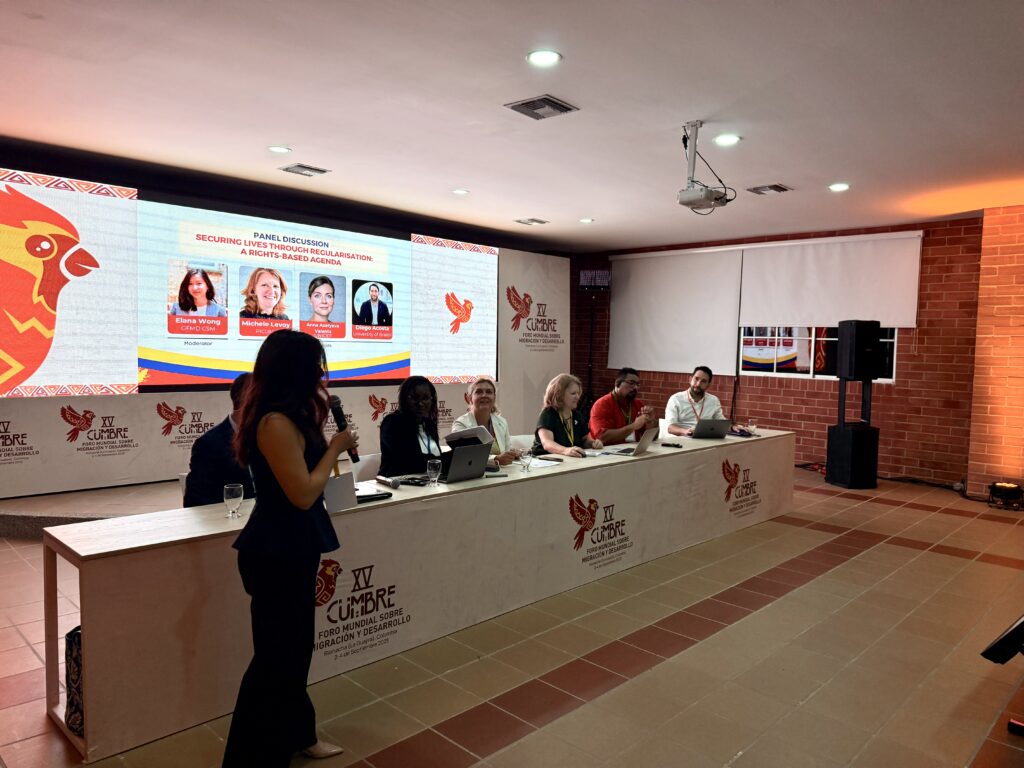
The side event was concluded with remarks from Fatima Diallo, Chair of the United Nations Committee on the Protection of the Rights of All Migrant Workers and Members of their Families. Charting the multiple vulnerabilities and possibilities for exploitation created by irregularity, she additionally highlighted how irregularity prevents positive migratory choices and experiences.
***
Read the OCHCR report Pathways to Compassion
Watch the PICUM video Regularisation works, and it’s the right thing to do